
 Fundraising Commons Team 4 min read
 Grateful patient fundraising and HIPAA: what donor data can a hospital foundation use?
About the Author
The open, vendor-neutral commons behind the Advancement Common Data Model (ACDM™) and its free educational resources. We write about trustworthy advancement data, portability, and AI-readiness for fundraising teams of any size. Stewards are credited in the colophon, never in the byline.
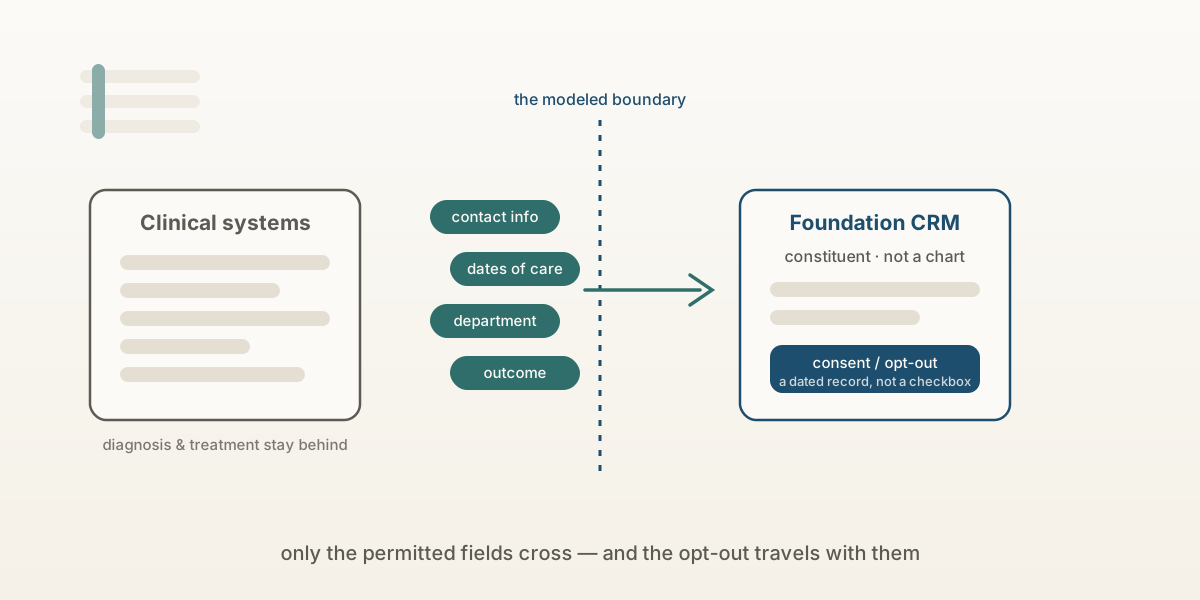
Yes, a hospital can fundraise from patients — HIPAA explicitly permits it, with a strictly limited set of data and a mandatory opt-out on every solicitation. The compliance question that actually sinks grateful patient programs isn’t “is this allowed?” It’s “can you prove which fields crossed from the clinical side to the foundation, and where the opt-out lives?” That’s not a legal problem. It’s a data-modeling problem, and it’s exactly the kind a common data model is built to solve.
Can a hospital use patient data for fundraising?
Under the HIPAA Privacy Rule’s fundraising provision (as amended by the 2013 Omnibus Rule), a covered entity may use — or share with its foundation — a specific, enumerated set of information for fundraising without patient authorization:
- Demographic and contact information (name, address, phone, email, age, gender)
- Dates of care
- General department of service (cardiology, not the diagnosis)
- Treating physician
- Outcome information
- Health insurance status
Everything else — diagnosis, treatment detail, clinical notes — requires the patient’s written authorization. And two obligations travel with the permitted data: every fundraising communication must carry a clear, conspicuous way to opt out, and an opt-out must actually stop future solicitations.
Not legal advice
This is a data-modeling post, not compliance guidance. The rule has edges — notice-of-privacy-practices language, how opt-outs may be scoped — that belong to your counsel and privacy officer. What follows is about making whatever they decide provable in the data.
The boundary is a data-modeling problem
Picture the audit conversation. The question is never abstract: it’s show me the fields that crossed the wall, show me the opt-out record, show me that the opted-out patient received nothing after that date. A foundation whose database is a CRM export enriched by hand cannot answer it. A foundation whose data maps to a neutral, enumerable shape can, because the boundary is written down:
- The constituent is not the patient record. The foundation holds a constituent — a relationship record built from the six permitted field families — never a copy of the chart. What crossed the wall is an enumerable list, not a habit.
- Consent is a first-class object, not a checkbox. The model carries consent as its own domain: what may be sent, to whom, on what basis, revoked when. An opt-out is a dated record with scope — which is what “honor the opt-out” means in practice.
- The gift officer’s world is already modeled. Portfolios, moves management, and interactions — the daily work of a grateful patient program — are core advancement domains, proven in the beta today.
- Privacy requests have a home. Retention rules and data-subject requests live in a privacy domain, so “delete this person” is an operation, not an archaeology project.
An auditor never asks “do you follow HIPAA?” They ask “show me which fields crossed from the EHR to the foundation, and where the opt-out lives.” Only a modeled boundary can answer.
Why a common model, and not just a careful one?
A hospital foundation could enforce all of this with in-house discipline. But the moment the data is described in one vendor’s proprietary shape, the boundary is only as durable as that vendor relationship — and healthcare philanthropy changes CRMs like everyone else. Mapping to a neutral shape makes the consent and privacy structures portable: the opt-out survives the migration, because it isn’t a custom field, it’s part of the spine. The same logic behind donor data privacy under GDPR and CCPA applies here with higher stakes: regulated data deserves a shape no vendor owns.
Honest maturity note: consent, privacy, and portfolio domains are in the model now — the current shape is in the open acdm repository. The healthcare-specific refinements (department-of-service fields, grateful patient program structures) are precisely what a hospital foundation in the beta would help shape.
Healthcare philanthropy and the beta
We’re working with advancement shops now, but the model is built to support your vertical — and healthcare foundations are closer to the beta cohort than any other. If you’re interested in joining, request access and we’re more than happy to discuss the possibilities.
This post is part of a series on the model beyond its first adopters — the umbrella view is who is the Advancement Common Data Model for?
For how the privacy-first foundation works, see How It Works; for the standard itself, The Standard (ACDM).
ACDM is open and early; treat current releases as drafts. Examples use synthetic data. This post is not legal advice.
Related Articles
Donor data privacy under GDPR and CCPA: what advancement teams need to know
If you hold data about EU/UK or California donors, GDPR and CCPA likely apply wherever your org sits. Here's what advancement teams need to know, in plain terms.
AI governance for donor data: a starter policy any shop can adopt
AI governance for donor data doesn't need a legal team. It needs a one-page policy answering a few concrete questions before any AI touches donor records. Here's the template.
Programs, beneficiaries, and grants: modeling the half of your data that isn't fundraising
Programs, beneficiaries, grants, and impact belong in the same data model as gifts. Connecting money to mission starts with one shared spine. Here's how.