
 Fundraising Commons Team 4 min read
 Trust your numbers: why we started the Fundraising Commons
About the Author
The open, vendor-neutral commons behind the Advancement Common Data Model (ACDM™) and its free educational resources. We write about trustworthy advancement data, portability, and AI-readiness for fundraising teams of any size. Stewards are credited in the colophon, never in the byline.
The Fundraising Commons is an open, vendor-neutral data standard for advancement, plus the free education to use it, built so that any team, at any budget, can trust its numbers and act on them. We started it because the sector can’t learn from itself, and the shops that can least afford it are being left furthest behind. This first post is the institutional why; for the personal one, the story behind it starts with a CRM migration that should have been simple and wasn’t.
What is the Fundraising Commons?
Two things, both free and openly licensed:
- An open data standard: a vendor-neutral way to describe advancement data (the Advancement Common Data Model) that maps to and from the CRMs you already use, so your records mean the same thing everywhere and aren’t trapped in one system’s shape.
- Practical education: guidance, worked examples, and a self-assessment that let a constrained, one-person shop actually succeed, end to end, without buying anything.
It belongs to no single company. The point isn’t a product; it’s a public good the whole sector can build on.
The problem we started with
Advancement data is trapped twice over. It’s siloed inside each institution, and it’s shaped differently by every CRM: what one system calls a donation, another splits into a commitment and a transaction; “lapsed” and “retention” drift from shop to shop. The result is a sector that can’t compare, calibrate, or benchmark without exposing donor records, where every team re-invents its definitions from scratch.
You can’t do real analytics on data you don’t trust. And you can’t trust data whose definitions live in three people’s heads and disagree.
Meanwhile the bar is rising. Analytics, and increasingly AI, are becoming the baseline expectation, and they’re only ever as good as the data beneath them. So the shops with budgets pull further ahead, and the constrained shops, serving missions just as worthy, fall further behind. The gap widens at the exact moment a shared foundation could close it.
Why an open standard, and why now
Three curves are crossing: CRMs keep proliferating (more shapes, more drift); AI keeps raising what “good” looks like (so the foundation matters more than ever); and budgets at small shops keep tightening (so that foundation is more out of reach than ever).
An open, neutral foundation answers all three at once. It’s portable, so no vendor’s roadmap is your ceiling. It’s shared, so the sector can finally compare notes. And it’s free, so a good foundation no longer requires a big-shop budget.
What we’re building (and what we’re not)
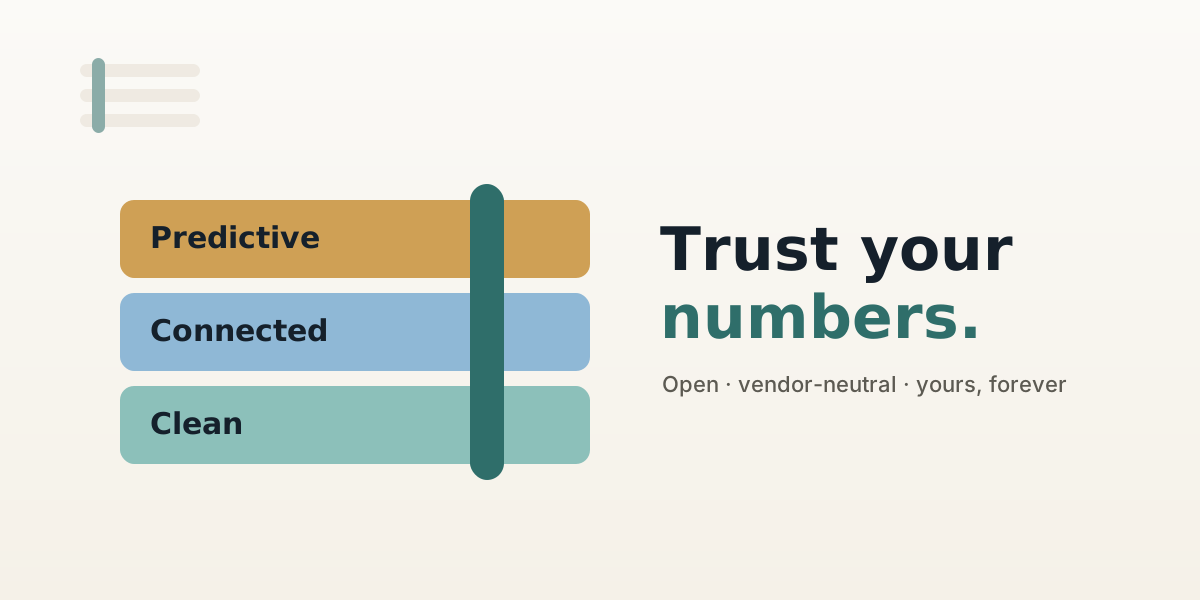
We climb one ladder, narrowly, again and again: Clean → Connected → Predictive.
- Clean: you can trust the number. Records are deduplicated; gifts are dated and attributed consistently; definitions are agreed and applied the same way every time.
- Connected: your data has a shape that isn’t a single vendor’s, so it can move and be reconciled.
- Predictive: clean, connected data feeds defined metrics and models you can act on.
We are not building another platform you’re stuck with, and we don’t monetize the standard. The standard is the public good; everything we publish is meant to stand on its own.
Our promise, stated plainly
Four commitments we intend to keep, and to be judged on:
- Your data is yours. Portability by design. We want leaving to be easy; that’s the proof you stayed by choice.
- The sector should learn from itself. Shared definitions and privacy-preserving comparison, without exposing a single donor record.
- A good foundation shouldn’t need a big budget. The standard and the knowledge are free.
- Definitions are the standard. A metric is a spec, not a name. Rigor is the product.
Early, and built in the open
This is the beginning, not a finished thing. The standard is in an early, alpha stage and will evolve in public. Treat current releases as drafts and expect it to improve as more people build on it. A commons earns trust by being governed transparently over time, not by claiming to be done on day one.
Where to start
If you only do one thing: take the free five-minute self-assessment to see where your shop sits on the ladder, then read the piece it points you to. From there, What Becomes Possible describes where this leads, How It Works shows the foundation, and Future-Proofing & AI is for the leader worried about what comes next.
Welcome. Let’s make your numbers trustworthy.
The standard and code live on GitHub. It’s open and early; treat current releases as drafts. Examples throughout this blog use synthetic data.
Related Articles
One year in: what building an open fundraising commons taught us
A year ago we said the sector can't learn from itself and small shops get left behind. Here's what's real, what the first year taught us, and what's still early. Honestly.
Why the fundraising sector can't learn from itself, and what a commons would change
Nonprofits can't benchmark against each other because data is trapped twice over and comparing has meant exposing donors. A commons changes both. Here's the whole argument.
A good data foundation shouldn't need a big budget
Can a small shop afford good data infrastructure? Yes. The trustworthy part is mostly discipline, not spend. Definitions, hygiene, and an open standard are free.