
 Fundraising Commons Team 4 min read
 AI-ready fundraising data: what it actually means (a readiness checklist)
About the Author
The open, vendor-neutral commons behind the Advancement Common Data Model (ACDM™) and its free educational resources. We write about trustworthy advancement data, portability, and AI-readiness for fundraising teams of any size. Stewards are credited in the colophon, never in the byline.
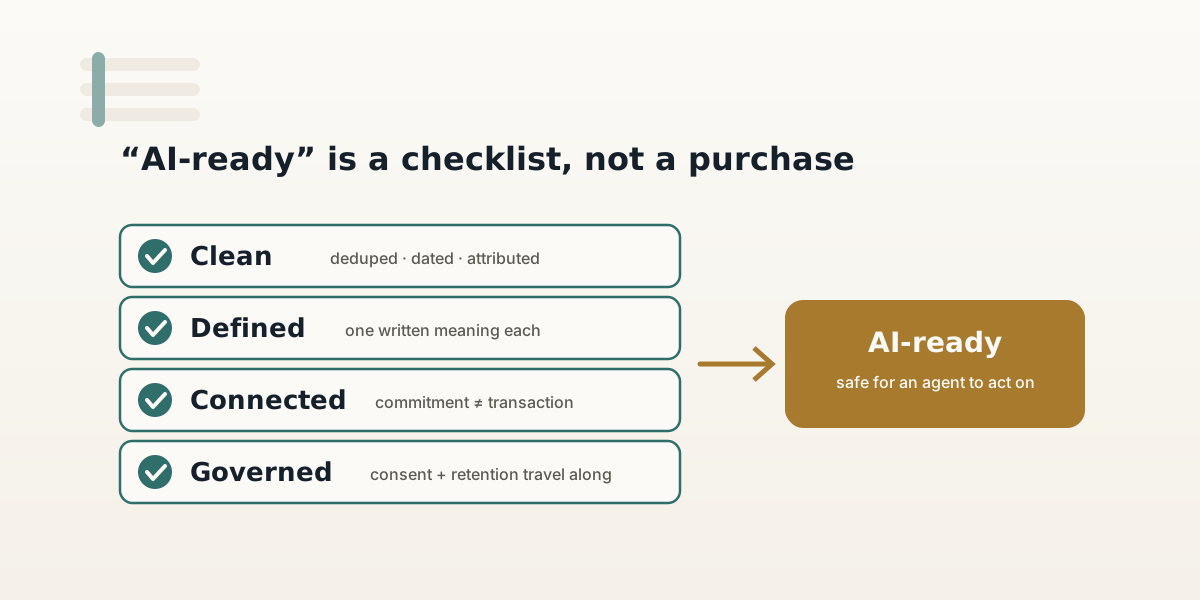
“AI-ready data” is not a product you switch on or a box a vendor ticks. It’s four properties your data either has or doesn’t: clean, defined, connected, and governed. If your records have all four, an AI tool or agent gives you a real edge. If they don’t, the AI faithfully amplifies whatever’s wrong. This post is the checklist; run your data against it before you wire anything autonomous to it.
How do nonprofits prepare data for AI?
Not by buying the AI first. The work that makes AI safe and useful is the ordinary discipline of trustworthy data, the same work that already makes your reports agree. We covered why this matters in you can’t run AI agents on rumors with a logo; this is the how: the four checks, what each means, and the failure you’re preventing.
The four-point readiness checklist
1. Clean: can you trust the record in front of the model?
- One person is one record (deduplicated).
- Gifts are dated consistently, so “when” is reliable (see gift date vs. entry date).
- Soft and hard credit are resolved, so “who gave” is right.
Prevents: an agent thanking a major donor based on their $500 duplicate, or asking someone for a gift they already made.
2. Defined: does every term mean one written thing?
- “Active,” “lapsed,” “major,” “retention” each have a single written definition, applied the same way every time (why your reports disagree).
- A human and the model would compute the same number from the same word.
Prevents: an agent acting on “lapsed donors” that means something different than you think, and emailing the wrong segment at scale.
3. Connected: does the data carry the distinctions that matter?
- A commitment is distinct from a transaction (a pledge is not a payment).
- Relationships and interactions are modeled, not just gifts (constituent 360 is a destination).
Prevents: an agent reading a mid-pledge donor as lapsed, or reasoning about a person from gifts alone.
4. Governed: is the data the agent touches one it’s allowed to use?
- Consent and retention rules travel with the data.
- The agent can only act on records it’s permitted to act on.
Prevents: automated outreach to people who opted out, or retention of data past what policy allows, now happening at machine speed.
The order matters
These aren’t parallel; they stack. Clean comes first (a defined metric on dirty data is still wrong), then defined, then connected, then governed on top. You can’t shortcut to “governed AI” on data that isn’t clean; the governance just politely manages a mess.
The honest readiness test
Pick one real automation you’d want, say an agent that drafts thank-yous or flags lapsed donors. Walk it through the four checks against your actual data. The first check it fails is your next project. That’s a roadmap, not a purchase order.
The work that makes AI safe is the work that already makes your reports trustworthy. There is no separate “AI data project.” There’s just good data, finally finished.
An honest note
This is an emerging area and the tooling is moving fast. The right posture isn’t to wait, and it isn’t to wire an autonomous agent to a messy database and hope; it’s to work the checklist now, so you’re genuinely ready when you adopt AI on your own terms. The standard and methods here are early and evolving; treat current releases as drafts.
What you get
A clear-eyed answer to “are we ready for AI?” that isn’t a sales pitch, plus a prioritized list of the exact data work that makes you ready, every item of which pays off even if you never deploy a single agent. Readiness is something you build, and you can start today.
For the leadership view on AI and disruption, see Future-Proofing & AI; to locate your data on the ladder, take the self-assessment.
Examples use synthetic data. The standard is open and early; treat current releases as drafts.
Related Articles
Agentic AI for fundraising: a glossary for nonprofit leaders
Agentic AI means software that takes actions, not just answers questions. Here's a plain-language glossary (agent, grounding, guardrails, hallucination) for fundraising leaders.
Future-proofing nonprofit technology: a leader's guide to not betting on the wrong platform
You can't predict the next disruption, so don't try to pick the platform that survives it. Future-proof by composition: an open, portable foundation that adapts. Here's how.
You can't run AI agents on rumors with a logo
Are AI agents safe to use on donor data? Only when that data is clean and governed. An agent acting on a duplicate fails at scale. Here's what AI-readiness takes.