
 Fundraising Commons Team 3 min read
 Constituent 360 is a destination, not a dashboard you buy
About the Author
The open, vendor-neutral commons behind the Advancement Common Data Model (ACDM™) and its free educational resources. We write about trustworthy advancement data, portability, and AI-readiness for fundraising teams of any size. Stewards are credited in the colophon, never in the byline.
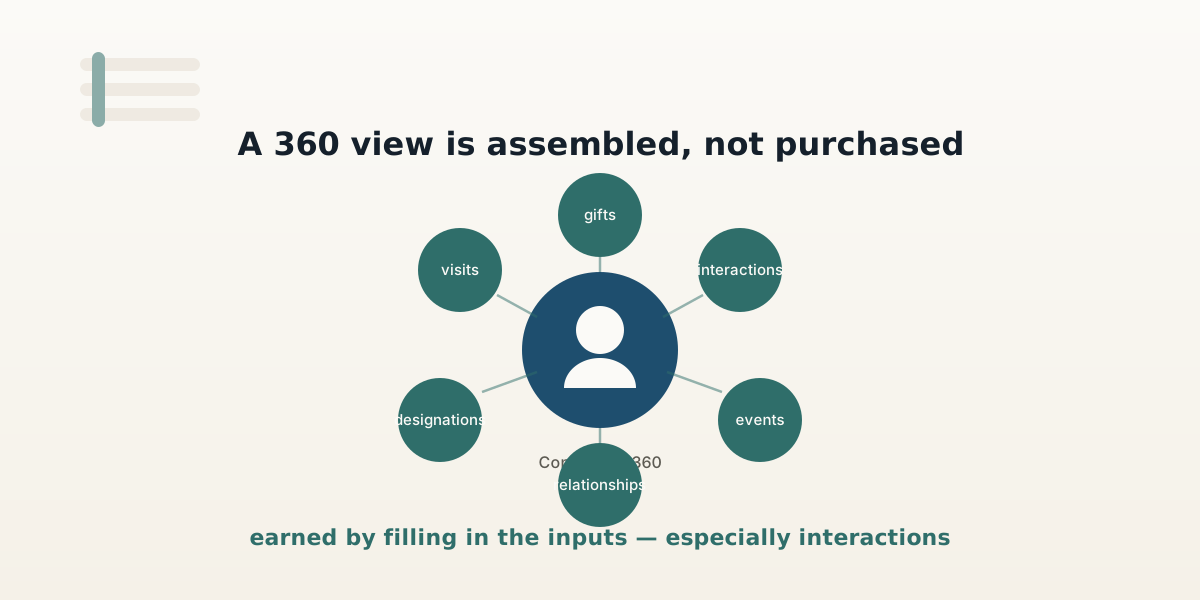
A constituent 360 view is a single, complete picture of a supporter: their gifts, relationships, and interactions, assembled over time. The thing most shops get wrong is treating it as a product you purchase. It isn’t. A 360 view is a destination you earn by modeling the engagement that isn’t a gift; a dashboard you buy before the inputs exist just shows you an expensive, mostly-empty circle.
What is a constituent 360 view?
It’s the answer to “everything we know about this person, in one place”: their giving history, the people and organizations they’re connected to, and every meaningful touchpoint: visits, calls, events attended, emails that landed. Done well, it lets a gift officer walk into a meeting already knowing the relationship, not just the donation total.
Why you can’t just buy it
The 360 view is assembled from data you already should be keeping. A vendor can sell you the screen that displays it, but the screen is only as complete as the inputs behind it, and the inputs are the part that takes work:
- Gifts you almost certainly have.
- Relationships (households, employers, soft-credit links) you may have partially.
- Interactions (the visits, calls, and contact reports) are the most under-filled object in most shops, and the one a 360 view needs most.
Buy the dashboard before you’ve captured the interactions, and you’ve bought a beautiful frame around a blank page.
The inputs come first
Each of the six objects every advancement CRM has feeds the 360 view, but two prerequisites decide whether it’s trustworthy:
- The data has to be clean and defined. If “this donor” is split across duplicate records, the 360 view shows half a person, twice over. The whole why your reports disagree problem shows up here as a fractured profile.
- Engagement has to be captured, not just gifts. A 360 view that only knows giving is a 90-degree view. The interactions (what you did together that wasn’t a transaction) are what make it round.
The empty-circle trap
A 360 dashboard with no interaction data doesn’t fail loudly. It just quietly shows gifts you already knew about, dressed up as insight. Capturing engagement is unglamorous and it’s the actual work; the visualization is the easy 10% at the end.
What it gives you once it’s real
When the inputs are there, the 360 view stops being a screen and starts doing work:
It’s also the substrate that everything predictive runs on. An agent or a model reasoning about a donor is only as good as the 360 view beneath it, which is why “buy the AI” has the same flaw as “buy the dashboard.” Both need the inputs first. (More on that in the readiness work ahead.)
How to actually get there
Don’t start with the dashboard. Start with the inputs, cheapest first:
- Clean the constituent record so one person is one record.
- Capture interactions: make logging a visit or call as routine as recording a gift. This is culture as much as software.
- Model the relationships that matter (households, employers, soft credits).
- Then add the view, by which point it has something true to show.
What you get
A picture of each supporter your team actually trusts and acts on (the relationship, not just the receipt), and the foundation that makes personalization and analytics possible later. The 360 view is the reward for doing the inputs, not a shortcut around them.
For the destination this builds toward, see What Becomes Possible; locate your shop with the self-assessment.
Examples use synthetic data. The standard is open and early; treat current releases as drafts.
Related Articles
Programs, beneficiaries, and grants: modeling the half of your data that isn't fundraising
Programs, beneficiaries, grants, and impact belong in the same data model as gifts. Connecting money to mission starts with one shared spine. Here's how.
Tithes, pledges, and three databases: mapping church giving to a common model
Yes, church giving maps to a common data model: members are constituents, tithes are gifts, pledge campaigns are commitments. Here's the full crosswalk.
Who is the Advancement Common Data Model for?
ACDM is for any organization that raises money: advancement shops in the beta today, with churches, hospitals, and human-services nonprofits designed in.