
 Fundraising Commons Team 4 min read
 Tithes, pledges, and three databases: mapping church giving to a common model
About the Author
The open, vendor-neutral commons behind the Advancement Common Data Model (ACDM™) and its free educational resources. We write about trustworthy advancement data, portability, and AI-readiness for fundraising teams of any size. Stewards are credited in the colophon, never in the byline.
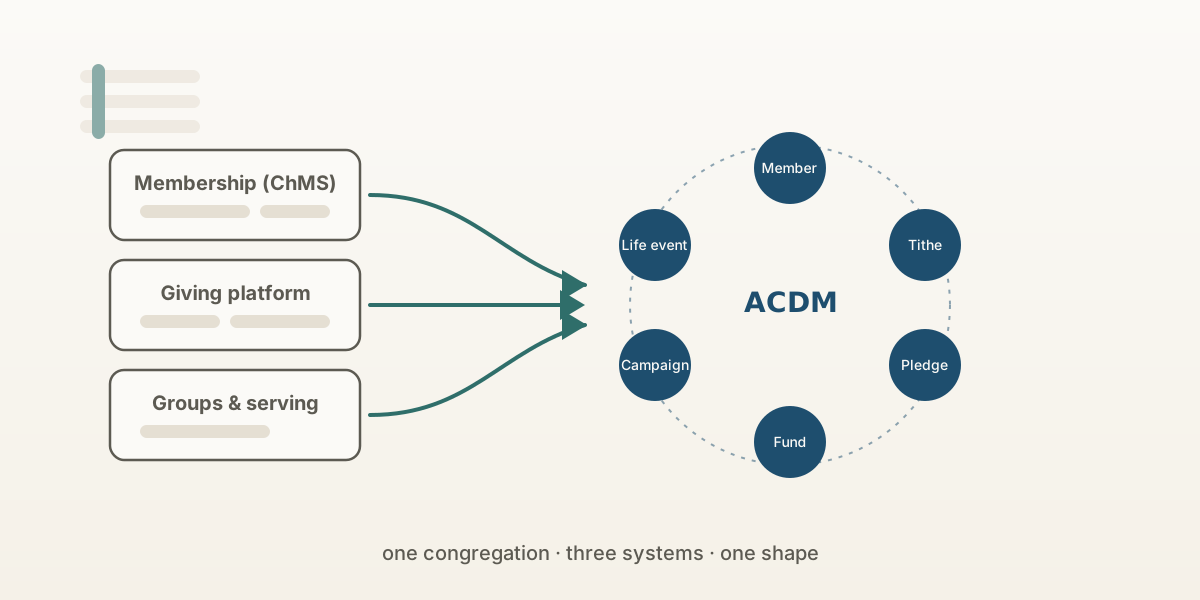
A large church typically runs at least three systems: a membership platform for people and households, a giving platform for online donations, and something else — spreadsheets, a groups tool, a legacy database — for everything in between. None of them agree on who a “member” is, and when the church switches giving platforms, years of history arrive as a CSV nobody fully trusts. The fix is the same one advancement shops use: map your data to a neutral shape that no vendor owns. Church giving maps cleanly, because underneath the vocabulary it’s the same six objects every fundraising database keeps.
Does a common data model work for churches?
Yes — and more naturally than you might expect, because the Advancement Common Data Model carries a dedicated congregation domain for faith communities: congregations, members, and their life events. That’s alongside the universal spine of constituents, gifts, commitments, designations, and campaigns. The current shape lives in the open acdm repository; the standard overview has the plain-English version.
Here’s the crosswalk from church vocabulary to the neutral objects:
| What your church calls it | Neutral object | The distinction that matters | |---|---|---| | Member, regular attender, visitor | Constituent | One person, one record — across the membership system and the giving platform | | Household, family unit | Relationship | Joint giving statements depend on modeling this, not guessing it | | Tithe, offering, online gift | Gift (transaction) | Money that actually arrived | | Building-campaign pledge, faith promise | Commitment | A promise of future giving — not a transaction | | Building fund, missions, benevolence | Designation / Fund | What a gift was for | | Capital campaign, year-end appeal, special offering | Campaign / Appeal | What asked for the gift | | Baptism, membership class, serving team | Life events & engagement | Contacts that aren’t gifts — the congregation domain’s home turf |
The distinction that breaks capital campaigns
The single most valuable line in that table is commitment versus transaction. A three-year building-campaign pledge is a promise; the monthly gifts that fulfill it are transactions. Blur the two — and most giving-platform exports do — and you get the same wrong numbers that plague universities: campaign totals that double-count, “lapsed” families who are actually current on their pledge, and year-end statements that don’t reconcile with the finance office. The full treatment is in a pledge is not a payment, and every word of it applies to a faith-promise campaign.
A tithe is a gift; a faith promise is a commitment. Blur them and your campaign total will lie to you exactly the way it lies to a university.
Two more church-specific traps the neutral shape forces you to decide on purpose:
- Household versus individual giving. Joint statements require knowing which spouse gave and how the household connects — that’s relationship modeling, the same soft-credit question advancement shops argue about.
- The calendar-year statement. Churches live on calendar-year giving statements while budgets may not; which date a December-31st online gift belongs to is a real decision, not a default.
What a church gets out of mapping
Three durable outcomes. Portability: when you outgrow a giving platform or a ChMS, your history moves with you, because it’s described in terms no vendor owns. Statements that reconcile: the finance office and the giving platform finally count from the same definitions. A foundation for later: benchmarking, analytics, and eventually AI all require exactly this kind of clean, well-defined data — the same readiness any organization needs.
Faith communities and the beta
We’re working with advancement shops now, but the model is built to support your vertical — the congregation domain is there and waiting for a real church to harden it. If you’re interested in joining the beta, request access and we’re more than happy to discuss the possibilities.
Where this sits in the bigger picture
This post is part of a series on the model beyond advancement — the umbrella view is who is the Advancement Common Data Model for? For the universal objects underneath the crosswalk above, see the six objects every advancement CRM has.
For the standard itself, see The Standard (ACDM).
ACDM is open and early; treat current releases as drafts. Examples use synthetic data.
Related Articles
Who is the Advancement Common Data Model for?
ACDM is for any organization that raises money: advancement shops in the beta today, with churches, hospitals, and human-services nonprofits designed in.
Programs, beneficiaries, and grants: modeling the half of your data that isn't fundraising
Programs, beneficiaries, grants, and impact belong in the same data model as gifts. Connecting money to mission starts with one shared spine. Here's how.
ACDM vs. NPSP, Salesforce Nonprofit Cloud, and Microsoft's NCDM
How does ACDM relate to NPSP, Salesforce Nonprofit Cloud, and Microsoft's Nonprofit Common Data Model? ACDM is a neutral layer that extends NCDM and maps to the others.