
 Fundraising Commons Team 4 min read
 What one misfired AI agent costs you: the duplicate-donor problem at scale
About the Author
The open, vendor-neutral commons behind the Advancement Common Data Model (ACDM™) and its free educational resources. We write about trustworthy advancement data, portability, and AI-readiness for fundraising teams of any size. Stewards are credited in the colophon, never in the byline.
When an AI agent runs on bad CRM data, it doesn’t fail quietly in a spreadsheet. It executes the error at full speed, across your whole list, in your organization’s voice. The single most expensive input error is the humble duplicate: one donor on two records. A person glances past it; an agent acts on it a thousand times. This post is about that cost, and why it’s almost never the AI’s fault.
What happens when AI runs on bad CRM data?
Three things, in sequence: the agent reads a record as true, it acts on it confidently, and it repeats that action across every similar record before anyone reviews a single one. The failure isn’t a crash you’d notice. It’s a thousand plausible, wrong actions that look exactly like normal operation until the complaints arrive.
This is the concrete, costed version of the argument in you can’t run AI agents on rumors with a logo. There, the thesis; here, the bill.
The duplicate-donor problem, at scale
A duplicate is two records for one person. To a human reviewing a list, the names match and instinct says “check that.” To an agent, they’re two different donors with two different histories, and it will treat them accordingly, every time.
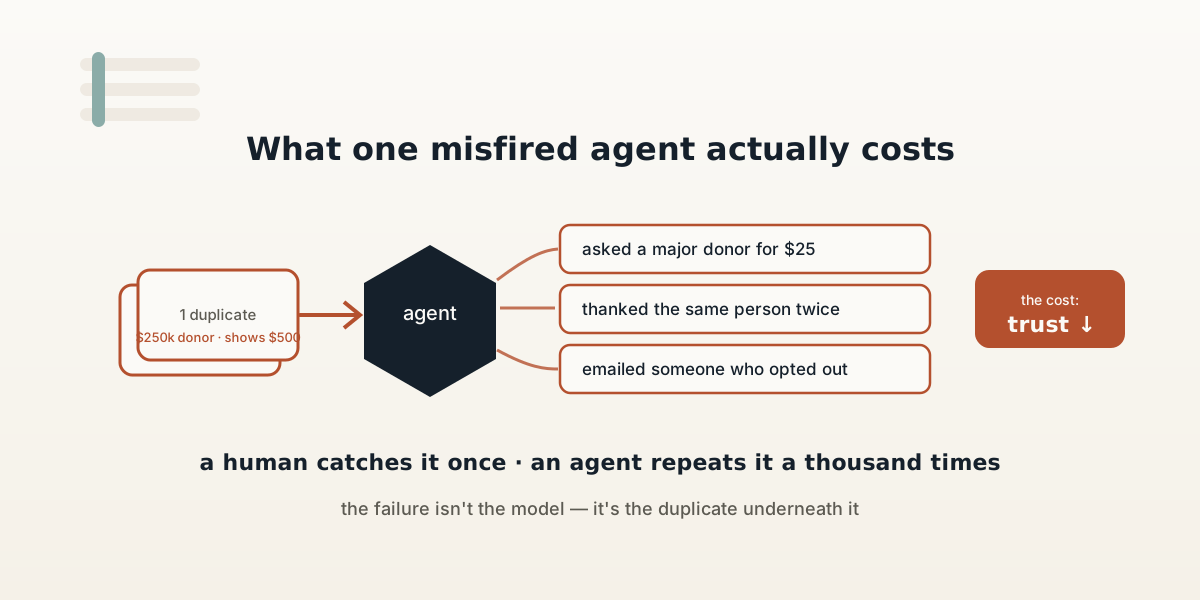
A human makes the duplicate mistake once and catches it. An agent makes it everywhere at once, in your name, and calls it done.
Now multiply. If duplicates are even 3% of your file and an agent is drafting personalized asks across 20,000 records, that’s 600 people getting an ask built on half their history, at machine speed, before review.
A worked example, with a cost
A synthetic major donor, Dana, exists on two records: one shows lifetime giving of $250,000; a stray duplicate shows $500 (illustrative). An outreach agent, optimizing ask amounts, reads the $500 record:
The agent asks Dana for $25. Best case, she’s bemused. Worst case, a relationship your team spent a decade building is quietly damaged by an email no human ever approved. Now imagine the same logic running across every duplicate in the file at once. The financial cost (a mis-sized ask) is real; the reputational cost (a donor who feels like a number) is worse, and it doesn’t show up on any report.
The cost is asymmetric
A staffer’s mistake is one bad email, caught at the next desk. An agent’s mistake is the entire segment, sent. And the currency it spends, donor trust, is the one currency you can’t buy back with a correction. Speed and scale turn a small data-quality gap into a large, public one.
Why the fix is upstream, not in the AI
It’s tempting to respond by tuning the agent: more rules, more review, a better prompt. But the agent did exactly what it was told; the record told it the wrong thing. You cannot prompt your way out of a duplicate. The fix lives upstream, in the data:
- Deduplicate, so one person is one record and the agent can’t read half a history. (The same duplicates that make “how many donors do we have?” have three answers.)
- Resolve credit, so the agent knows who actually gave (soft credit vs. hard credit).
- Separate commitments from transactions, so a mid-pledge donor isn’t read as lapsed (a pledge is not a payment).
That’s the AI-readiness checklist in action: clean, defined, connected, governed, before anything autonomous touches the file.
What to do before you deploy
Run one honest test: take the agent you’re considering, point it at a sample that includes your known duplicates and edge cases, and read what it would have sent. If it asks a major donor for $25, you’ve learned, for the price of a dry run, exactly what it would have cost you live.
What you get
An AI program that scales your good work instead of your worst records. A major-donor relationship that survives contact with automation. The confidence to deploy, because you fixed the data the agent stands on. The cheapest place to catch a misfired agent is before it fires.
For the leadership view on adopting AI safely, see Future-Proofing & AI; to check your readiness, take the self-assessment.
Examples use synthetic data. The standard is open and early; treat current releases as drafts.
Related Articles
You can't run AI agents on rumors with a logo
Are AI agents safe to use on donor data? Only when that data is clean and governed. An agent acting on a duplicate fails at scale. Here's what AI-readiness takes.
AI governance for donor data: a starter policy any shop can adopt
AI governance for donor data doesn't need a legal team. It needs a one-page policy answering a few concrete questions before any AI touches donor records. Here's the template.
Agentic AI for fundraising: a glossary for nonprofit leaders
Agentic AI means software that takes actions, not just answers questions. Here's a plain-language glossary (agent, grounding, guardrails, hallucination) for fundraising leaders.