
 Fundraising Commons Team 4 min read
 Donor data portability: how to test whether your data is really yours
About the Author
The open, vendor-neutral commons behind the Advancement Common Data Model (ACDM™) and its free educational resources. We write about trustworthy advancement data, portability, and AI-readiness for fundraising teams of any size. Stewards are credited in the colophon, never in the byline.
Your donor data is portable if you can move your full, meaningful history into another system and it’s still true: pledges still distinct from payments, soft credits intact, definitions preserved. Most shops assume they have this because their CRM has an export button. The only way to actually know is to run the drill. This post is the drill.
Is my donor data portable?
Portability isn’t “can I download a file.” It’s “if I had to leave, would my history survive the move as history, or arrive as a pile of disconnected rows?” That’s a higher bar, and it’s the one that matters, because the day you need portability (a forced migration, a vendor price hike, a sunset product) is the worst possible day to discover you don’t have it.
Portability is the property that your data lands somewhere else and is still true. An export is a pile of bricks; portability is keeping the house.
This is the testable half of the broader lock-in story in how to avoid CRM vendor lock-in without switching systems: that post makes the argument; this one is the measurement.
The export-button illusion
Every CRM exports. What an export usually drops:
- Relationships: which payments belong to which pledge, which gifts to which campaign, who’s in which household.
- Definitions: the meaning of “lapsed,” “active,” “major,” encoded in filters that don’t travel.
- Distinctions: commitment vs. transaction, hard vs. soft credit, gift date vs. entry date.
A file with all your rows but none of that is data you own without being data you can use. The export button proves you can extract; it proves nothing about whether you can rebuild.
The portability drill
Run this once a year, before you ever need it. It takes a sample, not your whole database:
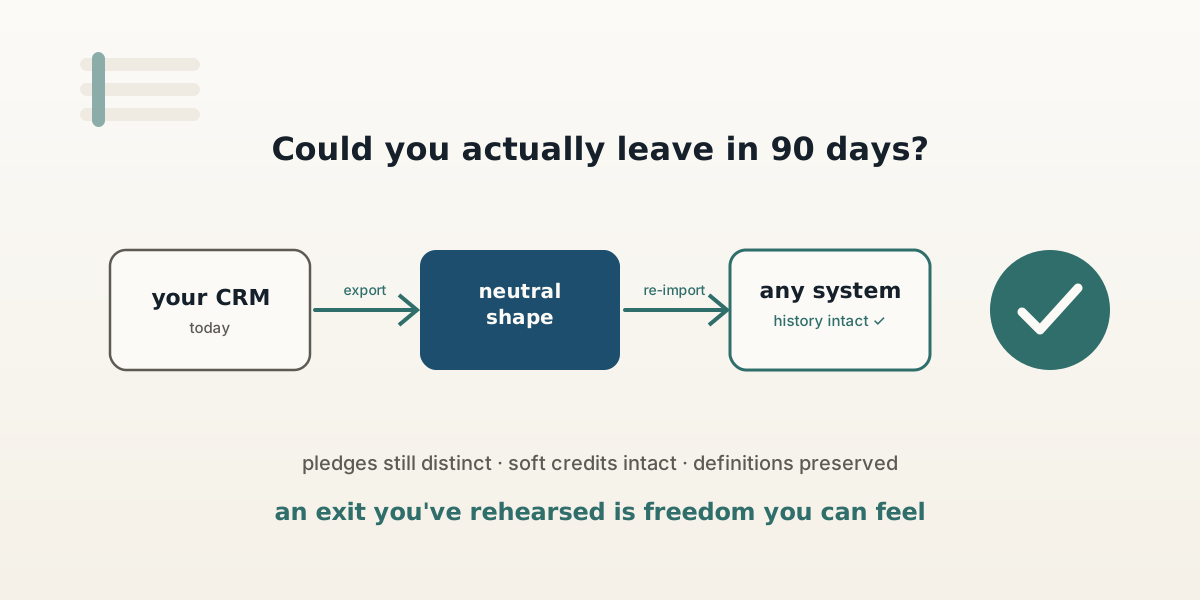
- Export a representative slice. Include pledges-in-progress, DAF gifts, matched gifts, households, and a few messy edge cases on purpose.
- Map it to an open, vendor-neutral shape (the Advancement Common Data Model is built to be that target), so it’s expressed in terms no single vendor owns.
- Re-import into a second environment, even a sandbox of a different tool, or a plain database.
- Diff the result against the original on the checklist below.
Why map to a neutral shape, not straight to another CRM
Going CRM-to-CRM just trades one vendor’s blind spots for another’s. Routing through an open, neutral model is what proves your history is expressed in terms no vendor controls, which is the actual definition of portable.
What “still true” means: the checklist
After the round-trip, confirm each of these survived:
- Pledges are still distinct from payments (the commitment vs. transaction line held).
- Soft credits are intact and not double-counting money (see soft credit vs. hard credit).
- Gift dates are preserved so fiscal attribution doesn’t shift (gift date vs. entry date).
- Households and relationships reconstructed, not flattened.
- Your definitions of active/lapsed still compute to the same numbers.
Score it: could you leave in 90 days?
The honest gut-check to bring to your next systems review: if you decided today to change CRMs, could you carry your full, meaningful history into a new system within 90 days, without paying a specialist to reverse-engineer your own data? “No” or “no idea” means you’re locked in regardless of your contract. “Yes, we’ve tested it” means you’ve already escaped, and you probably never have to.
What you get
A rehearsed exit you can feel, a stronger hand in every renewal conversation, and the confidence to adopt new capabilities without betting the organization. Portability isn’t mainly about leaving; it’s about being free to stay on your own terms.
For the leadership picture of a foundation you can walk away from, see How It Works. Locate your shop with the self-assessment.
Examples use synthetic data. The standard is open and early; treat current releases as drafts.
Related Articles
Adopting ACDM Without Rigason: The Zero-Vendor Blueprint
You don't need Rigason to benefit from the Advancement Common Data Model. Here is how to build a vendor-neutral data layer on top of Salesforce or Dynamics.
How to avoid CRM vendor lock-in without switching systems
You don't have to leave your CRM to escape lock-in. Make your data portable where it sits: map it to an open, neutral shape. Here's how, in three moves.
How an open standard stays neutral when a vendor funds it
Can a data standard funded by a vendor really be neutral? Yes, if neutrality is built, not claimed: open governance, conformance anyone can earn, and a tested way to leave.