
 Fundraising Commons Team 4 min read
 What is the Advancement Common Data Model (ACDM)?
About the Author
The open, vendor-neutral commons behind the Advancement Common Data Model (ACDM™) and its free educational resources. We write about trustworthy advancement data, portability, and AI-readiness for fundraising teams of any size. Stewards are credited in the colophon, never in the byline.
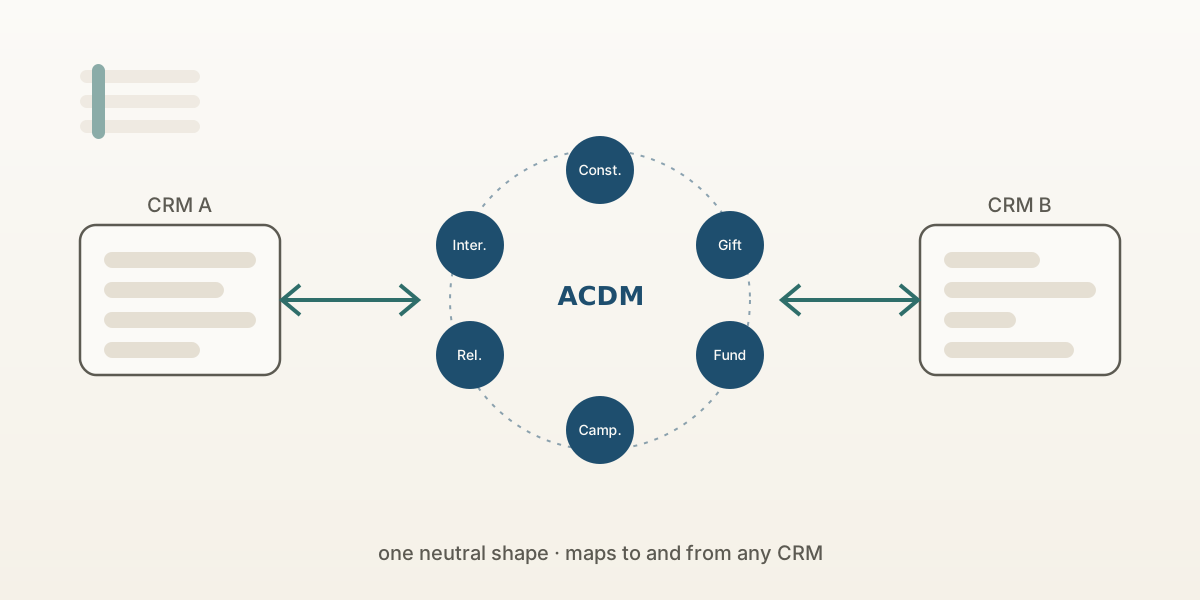
The Advancement Common Data Model (ACDM) is an open, vendor-neutral data model for advancement and fundraising data. It names the handful of objects every CRM already has, once and in the open, so your data maps to and from any system instead of being trapped in one vendor’s shape. It extends the open Nonprofit Common Data Model, it’s free to use, and it’s deliberately early.
What problem does ACDM solve?
Advancement data is trapped twice over. It’s siloed inside each institution, and it’s shaped differently by every CRM: what one system calls a “donation,” another splits into a commitment and a transaction; “lapsed” and “retention” drift from shop to shop. The result is that two databases describing the same reality can’t be compared, reconciled, or moved between systems without painful, bespoke translation every time.
A common data model fixes the shape problem. If everyone can describe their data against one neutral spine, then your history can move when you change systems, two of your own systems can be reconciled because they map to the same definitions, and the whole sector can eventually compare notes without re-inventing terms.
What’s actually in ACDM?
Every advancement CRM keeps the same small cast under different labels. ACDM names them neutrally:
- Constituent: the person or organization you have a relationship with.
- Gift: one recorded act of giving (the object every system names differently).
- Designation / Fund: what a gift was for.
- Campaign / Appeal: what asked for the gift.
- Relationship: how constituents connect (spouses, households, employers).
- Interaction: a contact that isn’t a gift: a visit, a call, an event attended.
The interesting work is in the distinctions the model draws on purpose and most exports blur. The big one: a commitment (a pledge or recurring promise) versus a transaction (the money arriving). Collapsing those two is the source of a surprising number of wrong numbers. The full, current list of entities and relationships lives in the open acdm repository, where it can evolve in the open rather than being frozen into a blog post.
Is ACDM a database, a product, or a standard?
A standard: a written specification, openly licensed, that anyone can build to. It is not a database you install, not a product you buy, and not tied to any one vendor.
A model that a competing CRM can adopt is, by definition, not any single company’s product. That competitors can conform is the strongest possible proof of neutrality.
Anyone, including vendors who compete with each other, can map their system to it and be listed in the public registry.
Do I have to switch CRMs to use it?
No. ACDM is a mapping target, not a replacement. You keep the system you have and describe your data in neutral terms alongside it. That mapping is what makes your data portable: you adopt the model without a rip-and-replace, and you’d be able to leave any tool later because your history already speaks a language no single vendor owns. (More on what that foundation looks like in How It Works.)
How mature is ACDM?
Early and evolving.
Treat current releases as drafts
The model is in an alpha stage and the spec will move. Entities will be added, names refined, and edge cases worked out in the open. Link to the repository rather than copying schema into your own docs, and expect change. A standard earns trust by being governed transparently over time, not by pretending to be finished on day one.
Where the spec lives
- The canonical, current shape: the open acdm repository.
- The plain-English gist of the objects above, and why each matters, is maintained in the project glossary.
- Before any of this matters, your definitions have to agree. That’s the work behind “how many donors do we have?” why one question has three answers.
For the leadership view on why an open, neutral foundation is the safe thing to build on, see The Standard (ACDM) and How It Works.
ACDM is open and early; treat current releases as drafts. Examples use synthetic data.
Related Articles
Tithes, pledges, and three databases: mapping church giving to a common model
Yes, church giving maps to a common data model: members are constituents, tithes are gifts, pledge campaigns are commitments. Here's the full crosswalk.
Who is the Advancement Common Data Model for?
ACDM is for any organization that raises money: advancement shops in the beta today, with churches, hospitals, and human-services nonprofits designed in.
ACDM vs. NPSP, Salesforce Nonprofit Cloud, and Microsoft's NCDM
How does ACDM relate to NPSP, Salesforce Nonprofit Cloud, and Microsoft's Nonprofit Common Data Model? ACDM is a neutral layer that extends NCDM and maps to the others.