
 Fundraising Commons Team 3 min read
 The monolith trap: buying a whole platform for one feature
About the Author
The open, vendor-neutral commons behind the Advancement Common Data Model (ACDM™) and its free educational resources. We write about trustworthy advancement data, portability, and AI-readiness for fundraising teams of any size. Stewards are credited in the colophon, never in the byline.
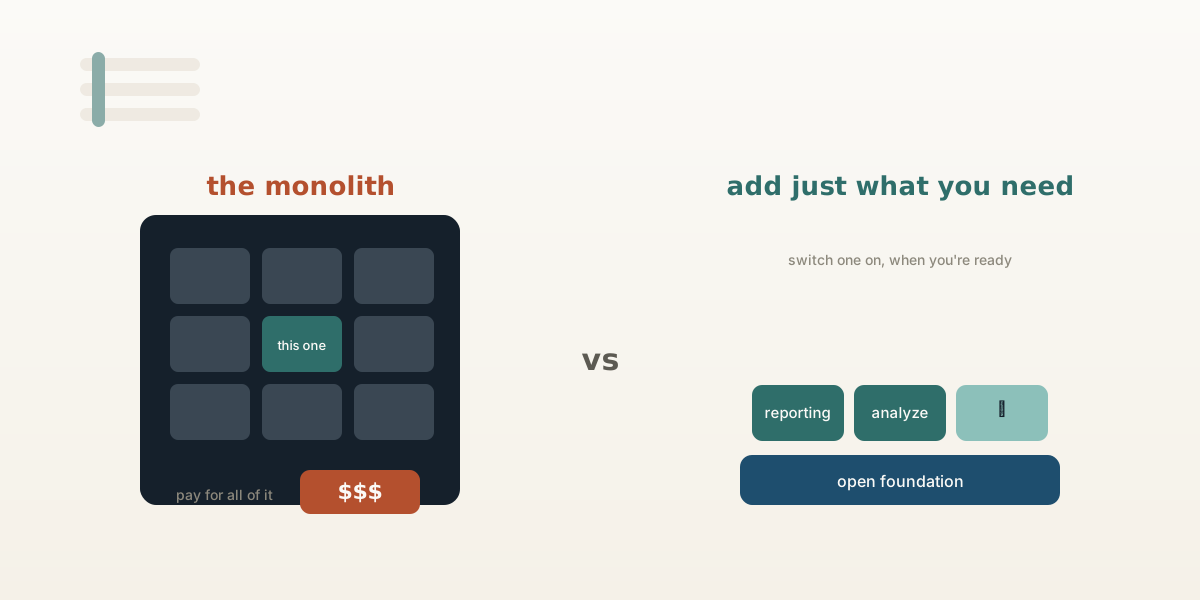
You need one new capability: reporting, say, or a place to analyze, or some automation. The sector’s reflex answer is to buy a whole new platform to get it. That’s the monolith trap: you pay for, migrate into, and get locked to an entire suite to solve a single gap. There’s a cheaper, safer path: add the one capability you actually need, on top of the data you already have.
Can we add reporting (or AI) without replacing our CRM?
Yes. The belief that you can’t is the trap itself. A capability gap (“we have no good reporting”) gets reframed by vendors as a platform decision: to get reporting, adopt our suite. But reporting is a feature, not a reason to re-platform. The same is true of analytics, dashboards, and most AI tooling. If your data has a usable, portable shape, you can switch on the missing piece without ripping out what works.
Why the monolith is a trap, not a solution
Three costs hide inside “just buy the platform”:
- You pay for all of it to use one part. The pricing, the migration, the retraining are all sized to the suite, justified by the single feature you came for.
- You inherit a new silo. The capability you bought now lives inside another vendor’s walls, shaped their way, with your data copied in. You’ve added a dependency, not removed one.
- You re-lock your exit. Every monolith you adopt is another set of definitions and relationships encoded in someone’s proprietary model, which is the exact thing that makes leaving expensive. (See how to avoid CRM vendor lock-in.)
A missing feature is not a reason to re-platform. It’s a reason to add a feature to data you already own, in a shape no single vendor controls.
The alternative: add capability to a foundation you own
The composable path flips the order. Instead of buy the suite, then fit your data into it, you keep your data in an open, portable shape and switch on the one capability you need, when you need it.
| The monolith path | The composable path | |---|---| | Buy a whole platform | Add one capability | | Migrate everything | Keep what works | | Pay suite-sized pricing | Pay for the piece | | New silo, new lock-in | Same portable foundation |
This is only possible if the foundation underneath is sound, with your definitions written down and your data in a neutral shape. That groundwork is what makes “add just the missing piece” a real option and not just a wish, and it’s why a good foundation doesn’t need a big budget: you spend on the one capability, not the whole cathedral.
The question to ask a platform vendor
“I need this one capability. What do I have to adopt to get it, and can I get it without moving my data into your model?” If the honest answer is “adopt the whole suite and migrate,” you’ve found a monolith. Note whether your data could still leave afterward.
When a platform is the right call
This isn’t anti-software. Sometimes a suite genuinely is the best fit: a tiny team that wants one vendor to run everything, or a capability so core you’ll use most of the suite anyway. The trap isn’t buying a platform; it’s buying a whole platform for one feature, without checking whether you could have added just that feature and kept your exit. Make it a deliberate choice, not a reflex, and confirm your data stays portable either way (the portability drill tells you).
What you get
The capability you actually came for, without the migration, the suite-sized invoice, or the new silo. The foundation stays yours, still portable, and ready for the next gap you’ll need to fill. You grow into capability piece by piece instead of betting the organization on one box.
For the leadership picture of growing into an open foundation, see What Becomes Possible and How It Works.
Examples use synthetic data. The standard is open and early; treat current releases as drafts.
Related Articles
Adopting ACDM Without Rigason: The Zero-Vendor Blueprint
You don't need Rigason to benefit from the Advancement Common Data Model. Here is how to build a vendor-neutral data layer on top of Salesforce or Dynamics.
Why the fundraising sector can't learn from itself, and what a commons would change
Nonprofits can't benchmark against each other because data is trapped twice over and comparing has meant exposing donors. A commons changes both. Here's the whole argument.
How an open standard stays neutral when a vendor funds it
Can a data standard funded by a vendor really be neutral? Yes, if neutrality is built, not claimed: open governance, conformance anyone can earn, and a tested way to leave.