
 Fundraising Commons Team 3 min read
 ACDM vs. NPSP, Salesforce Nonprofit Cloud, and Microsoft's NCDM
About the Author
The open, vendor-neutral commons behind the Advancement Common Data Model (ACDM™) and its free educational resources. We write about trustworthy advancement data, portability, and AI-readiness for fundraising teams of any size. Stewards are credited in the colophon, never in the byline.
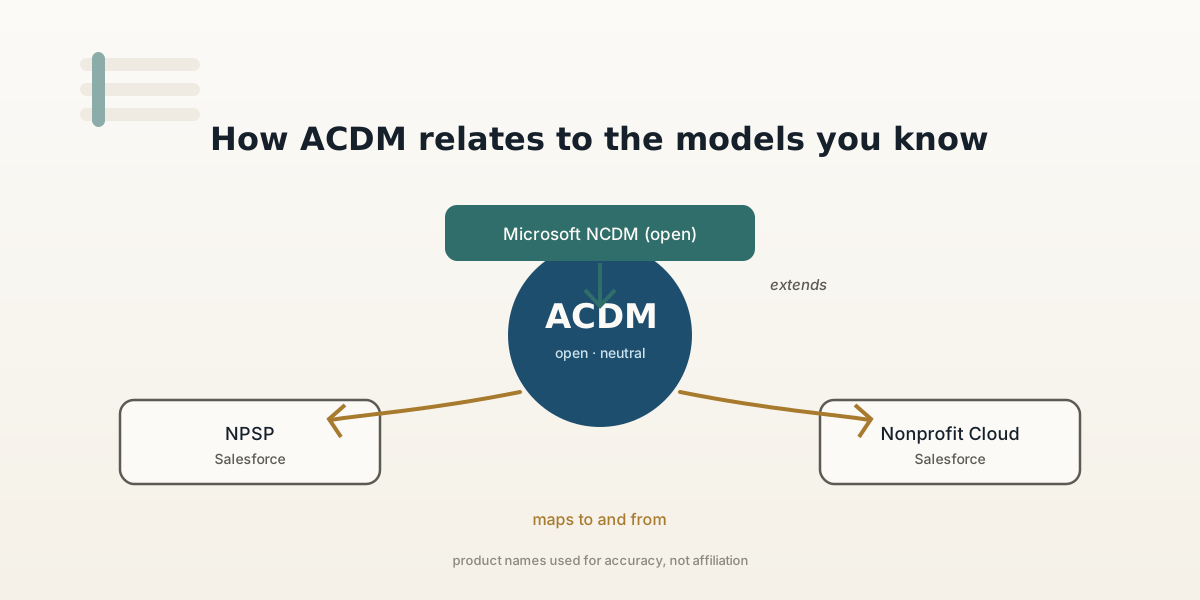
How does the Advancement Common Data Model (ACDM) relate to the models you already know: NPSP, Salesforce Nonprofit Cloud, and Microsoft’s Nonprofit Common Data Model (NCDM)? Short version: ACDM is a vendor-neutral layer focused on advancement that extends the open NCDM and maps to and from product data models like NPSP and Nonprofit Cloud. It’s not a competitor to your CRM’s model; it’s the neutral target they can all line up against.
Product and standard names below are used for accurate description and interoperability only. They do not imply endorsement or affiliation.
The quick comparison
| | What it is | Owned/published by | Role | |---|---|---|---| | NPSP | A data model + managed package on Salesforce | A vendor ecosystem | A product data model | | Salesforce Nonprofit Cloud | The newer first-party nonprofit data model on Salesforce | A vendor | A product data model | | Microsoft NCDM | The open Nonprofit Common Data Model | Published openly by Microsoft | An open, cross-sector base model | | ACDM | The Advancement Common Data Model | The open Fundraising Commons | A neutral, advancement-focused standard |
How does ACDM relate to NCDM?
ACDM extends NCDM. Microsoft’s Nonprofit Common Data Model is a broad, openly-published base covering nonprofit operations generally. ACDM builds on that foundation and goes deep on the advancement-specific distinctions a fundraising shop actually lives or dies by (commitment vs. transaction, soft vs. hard credit, designation, campaign attribution) at a level of rigor a general model doesn’t need to.
This is a familiar pattern: an open base model, with a focused extension for a specific domain. ACDM is the advancement extension.
How does it relate to NPSP and Nonprofit Cloud?
It maps to and from them. NPSP and Nonprofit Cloud are product data models, excellent at what they do and tied to a vendor ecosystem. ACDM doesn’t replace either; it sits beside them as a neutral target your data can be expressed in, so the same facts can move between systems without losing meaning.
ACDM isn’t another CRM model competing for your data. It’s the neutral shape the others can all map to, including the ones that compete with each other.
If the six-object foundation is new to you, the six objects every advancement CRM has is the place to start; for why neutrality is the load-bearing property, see what is a vendor-neutral common data model.
Why have a separate neutral model at all?
A fair question: if NPSP, Nonprofit Cloud, and NCDM exist, why ACDM?
- Product models are tied to a vendor. Building your portability strategy on one ties your exit to that vendor’s roadmap. A neutral model is owned by no one you buy from.
- General models aren’t advancement-deep. A cross-sector base doesn’t need to nail recurring-churn denominators or DAF attribution; an advancement standard does.
- Neutrality enables benchmarking. Shops on different CRMs can only compare notes against a shared, neutral definition, not against any one product’s model.
The interoperability test
A neutral model proves itself by what it connects, not what it replaces. The goal isn’t to win against NPSP or Nonprofit Cloud; it’s to let data described in any of them line up with data in any other. A standard a competitor can map to is, by definition, not a product.
Where the detail lives
This is the builder-facing view; the actual entities, fields, and conformance live in the open acdm repository (alpha, evolving; treat releases as drafts). For the leadership framing of what ACDM is and why it’s safe to build on, see what is the Advancement Common Data Model?.
What you get
A clear map of where the neutral standard fits among the models you already use, so you can adopt ACDM as a portability and benchmarking layer without abandoning NPSP, Nonprofit Cloud, or anything else. It’s the connective tissue, not a replacement.
For the builder/standard view, see The Standard (ACDM). Product names are used for interoperability description only.
Examples use synthetic data. The standard is open and early; treat current releases as drafts.
Related Articles
Tithes, pledges, and three databases: mapping church giving to a common model
Yes, church giving maps to a common data model: members are constituents, tithes are gifts, pledge campaigns are commitments. Here's the full crosswalk.
Who is the Advancement Common Data Model for?
ACDM is for any organization that raises money: advancement shops in the beta today, with churches, hospitals, and human-services nonprofits designed in.
How Competitors Win by Conforming to ACDM
Why would a CRM vendor or consultant build to a standard funded by their competitor? Because standardizing reduces integration costs and builds trust.