
 Fundraising Commons Team 4 min read
 DAF gifts: who's the legal donor, and why your attribution breaks
About the Author
The open, vendor-neutral commons behind the Advancement Common Data Model (ACDM™) and its free educational resources. We write about trustworthy advancement data, portability, and AI-readiness for fundraising teams of any size. Stewards are credited in the colophon, never in the byline.
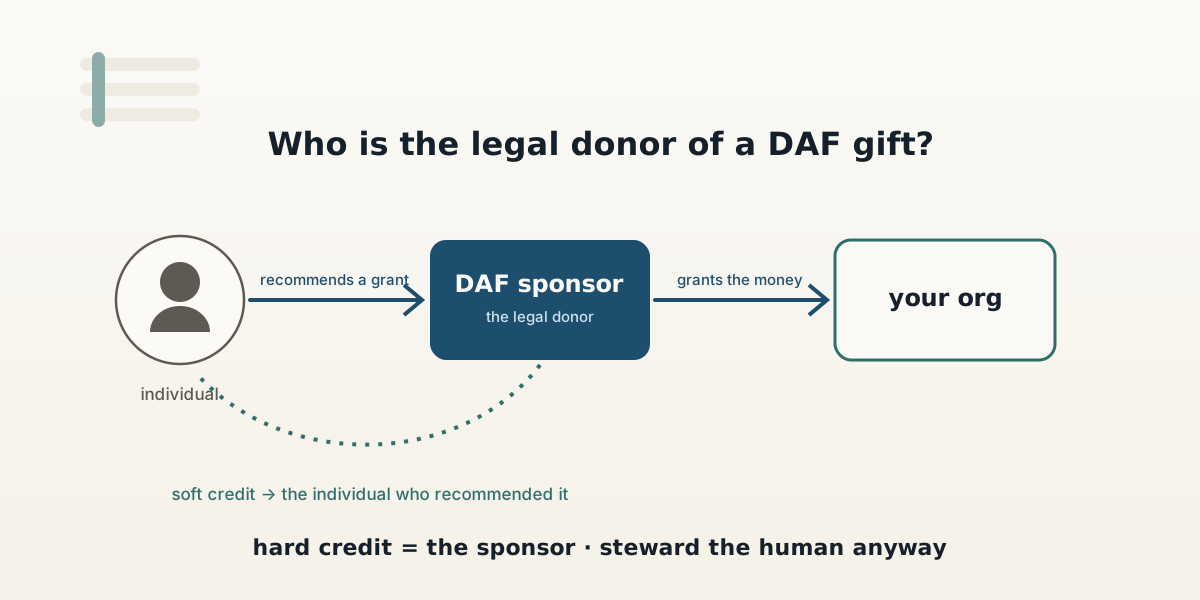
For a gift that arrives from a donor-advised fund (DAF), the legal donor (the hard credit) is the fund sponsor, not the individual who recommended the grant. The individual gets soft credit. Record it the other way around, as many shops do by reflex, and three things break at once: tax acknowledgment, revenue totals, and the stewardship of the human who actually directed the gift.
Who is the legal donor of a DAF gift?
The money in a donor-advised fund legally belongs to the sponsoring organization (a community foundation or a commercial sponsor) once the individual contributes it. When a grant is made to you, it’s the sponsor that gives, on the individual’s recommendation. So:
- Hard credit (legal donor): the DAF sponsor.
- Soft credit (recognition): the individual who recommended the grant.
The human chose you. The sponsor’s legal entity sent the money. Both facts are true, and your records have to hold both without confusing which is which.
Why this is so easy to get wrong
Everything about the relationship says “this is Dana’s gift”: Dana cultivated it, Dana cares, Dana expects a thank-you. So staff instinctively record Dana as the donor. But everything about the legal and tax reality says the sponsor gave, because the individual already took their deduction when they funded the DAF.
The individual chose you; the sponsor gave the money. Steward the human warmly, but the legal donor of record is the sponsor.
What breaks if you record the individual as the legal donor
Three failures, all common:
- Improper acknowledgment. You may send the individual a tax receipt for a gift they can’t deduct again (they already deducted it when funding the DAF). At best it’s confusing; at worst it’s wrong.
- Double-counted or mis-counted revenue. If you record the individual as the hard-credit donor and also capture the sponsor, you can count the money twice, or attribute it to the wrong entity for finance.
- Broken stewardship and soft credit. If “Dana gave” is recorded as hard credit, your soft-credit logic has nothing to attach to, and your top-donor and household rollups quietly distort. This is the soft credit vs. hard credit problem in its sharpest form.
A worked example
A synthetic $10,000 DAF grant directed by Dana through a community foundation (figures illustrative):
| Party | Role | In your records | |---|---|---| | Community foundation (sponsor) | legal donor | Hard credit, $10,000: the gift; tax receipt goes here | | Dana (recommended the grant) | the human who chose you | Soft credit, $10,000: recognition, no second receipt |
Dana sees the gift in her giving summary and gets a warm, non-tax thank-you; the sponsor is the donor of record and receives the receipt; the $10,000 counts once. Everyone is recognized correctly and the books reconcile.
How to model it cleanly
Don't issue a tax receipt to the DAF advisor
The individual already received their deduction when they funded the DAF. Acknowledge them warmly, but the tax-substantiation receipt belongs to the sponsor, the legal donor. Mixing these up is the most common DAF compliance slip.
Three habits keep it right:
- Hard-credit the sponsor; soft-credit the individual. One gift, recorded once, credited to the human for stewardship.
- Receipt the legal donor only. Steward the advisor with a non-receipt acknowledgment.
- Keep one money figure. Revenue is the sum of gifts, never the sum of credits, so the soft credit recognizes without adding dollars.
Modeling who-gave and who-gets-credit as distinct, linked facts is exactly what the six objects every advancement CRM has and the shared model in what is the Advancement Common Data Model? are built to support.
What you get
Clean tax compliance, revenue that reconciles, and a donor who feels properly thanked without a receipt that shouldn’t exist. Given how fast DAF giving is growing, that distinction is worth getting right now rather than untangling later.
For the builder/standard view, see The Standard (ACDM); locate your shop with the self-assessment.
Examples use synthetic data. The standard is open and early; treat current releases as drafts.
Related Articles
A pledge is not a payment: commitment vs. transaction explained
A pledge is a promise to give; a payment is the money arriving. Collapse the two and you get false lapses and missed churn. Here's the distinction that fixes it.
Programs, beneficiaries, and grants: modeling the half of your data that isn't fundraising
Programs, beneficiaries, grants, and impact belong in the same data model as gifts. Connecting money to mission starts with one shared spine. Here's how.
Tithes, pledges, and three databases: mapping church giving to a common model
Yes, church giving maps to a common data model: members are constituents, tithes are gifts, pledge campaigns are commitments. Here's the full crosswalk.