
 Fundraising Commons Team 4 min read
 Privacy-preserving analytics: what "raw donor data never leaves your walls" really means
About the Author
The open, vendor-neutral commons behind the Advancement Common Data Model (ACDM™) and its free educational resources. We write about trustworthy advancement data, portability, and AI-readiness for fundraising teams of any size. Stewards are credited in the colophon, never in the byline.
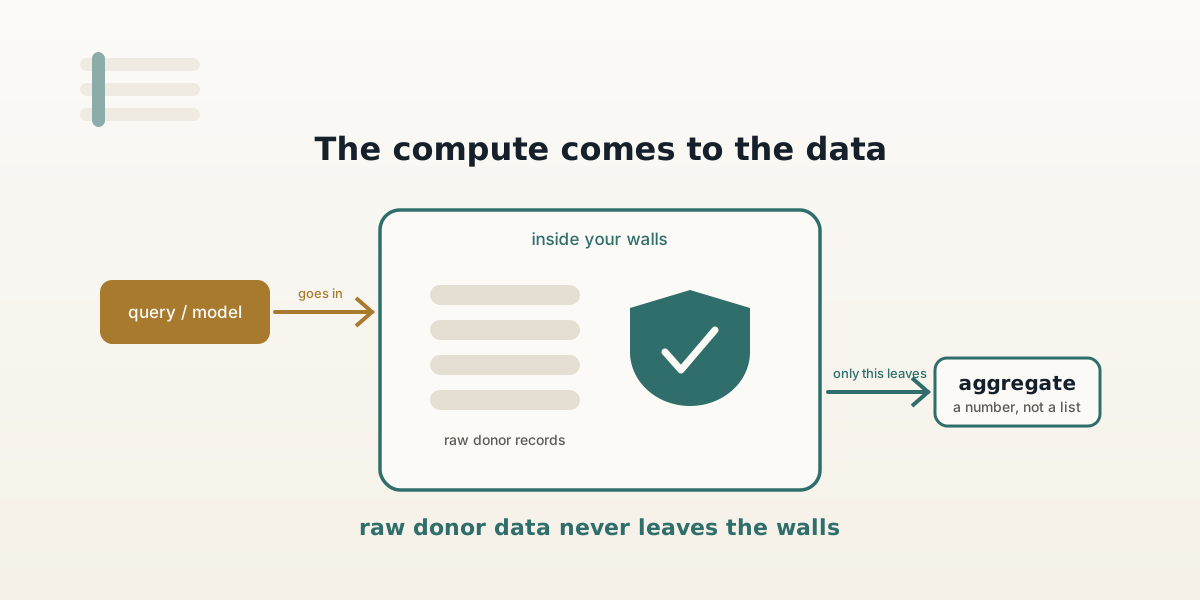
Privacy-preserving analytics flips the usual arrangement: instead of sending your donor data to where the computation lives, you send the computation to where your data lives. The query or model runs inside your walls, against your raw records, and only the result ever leaves: an aggregate, a number, never a list of people. That’s what “raw donor data never leaves your walls” actually means, mechanically.
How can nonprofits analyze data privately?
By separating two things most systems fuse: the computation and the data. Traditional analytics copies your data out to a platform and computes there, which means your donors now live somewhere else. Privacy-preserving analytics keeps the data put and moves the computation to it, so you get the insight without ever exposing the records that produced it.
The shift: compute comes to the data
Picture your donor records behind a wall:
- A query or model goes in. The thing that needs an answer (“what’s our retention by segment?”, a propensity model, a benchmark calculation) travels into your environment.
- It runs locally, on raw data. The computation happens where the records already are. They don’t move.
- Only an aggregate comes out. What leaves is a summary (a rate, an average, a coefficient), not a row-level export. A number, not a name.
You don’t have to choose between insight and privacy. Send the question to the data, and let only the answer come back out.
This is the engine under benchmarking without exposing donor data: each org computes locally against a shared definition, and only the aggregates are ever compared. Same principle, whether you’re comparing to peers or just analyzing your own data through an outside tool.
Why this matters
For an advancement shop, it dissolves a dilemma that usually ends in “we just won’t do the analysis”:
- A CISO can say yes. Nothing sensitive is shipped to a third party, so the risk review is a different, and far shorter, conversation.
- It honors what donors expect. Their records stay with the organization they gave to, not copied into an analytics vendor’s cloud.
- It fits the rules. Regimes like GDPR and CCPA scrutinize moving personal data; not moving it sidesteps the hardest part. (We covered the regulatory side in the privacy-and-donor-data discussion the standard draws on.)
What “aggregate” has to mean to be safe
“Only aggregates leave” isn’t automatically safe. A statistic computed over a handful of people can still leak information about them.
Aggregates need thresholds
A real implementation enforces minimum group sizes before any number is released, suppresses cells too small to be safe, and checks that combinations of results can’t be triangulated back to an individual. “It’s just a summary” is necessary but not sufficient; the summary itself needs guardrails. This is an area the standard is developing carefully and in the open.
What you need to make it work
Two foundations, both of which we’ve covered:
- Defined metrics, so the aggregate that leaves means the same thing every time it’s computed (why your reports disagree).
- A clean, connected base, so the local computation is running on data worth trusting in the first place (the AI-readiness checklist describes the same properties).
An honest note
Privacy-preserving analytics here is early and evolving. The architecture (compute-to-data, aggregates-only, with cohort thresholds) is the durable principle; the tooling that makes it turnkey is still maturing. Treat current releases as drafts, and expect the safeguards to sharpen.
What you get
Analysis you were previously too cautious (or too compliant) to run, done without copying a single donor out of your control. You keep both the insight and the promise you made to your donors, which used to feel like a trade and no longer has to.
For the security/leadership framing, see How It Works and the FAQ.
Examples use synthetic data. The standard is open and early; treat current releases as drafts.
Related Articles
Synthetic donor data: how to test cadences and policies safely
Synthetic donor data is artificial records that mirror your real data's patterns but describe no actual person, so you can test cadences, models, and policies without risk.
Grateful patient fundraising and HIPAA: what donor data can a hospital foundation use?
HIPAA allows grateful patient fundraising with a limited data set and a required opt-out. Here's how to model that boundary so you can prove it's respected.
Donor data privacy under GDPR and CCPA: what advancement teams need to know
If you hold data about EU/UK or California donors, GDPR and CCPA likely apply wherever your org sits. Here's what advancement teams need to know, in plain terms.