
 Fundraising Commons Team 4 min read
 Recurring donor churn: why your denominator is wrong
About the Author
The open, vendor-neutral commons behind the Advancement Common Data Model (ACDM™) and its free educational resources. We write about trustworthy advancement data, portability, and AI-readiness for fundraising teams of any size. Stewards are credited in the colophon, never in the byline.
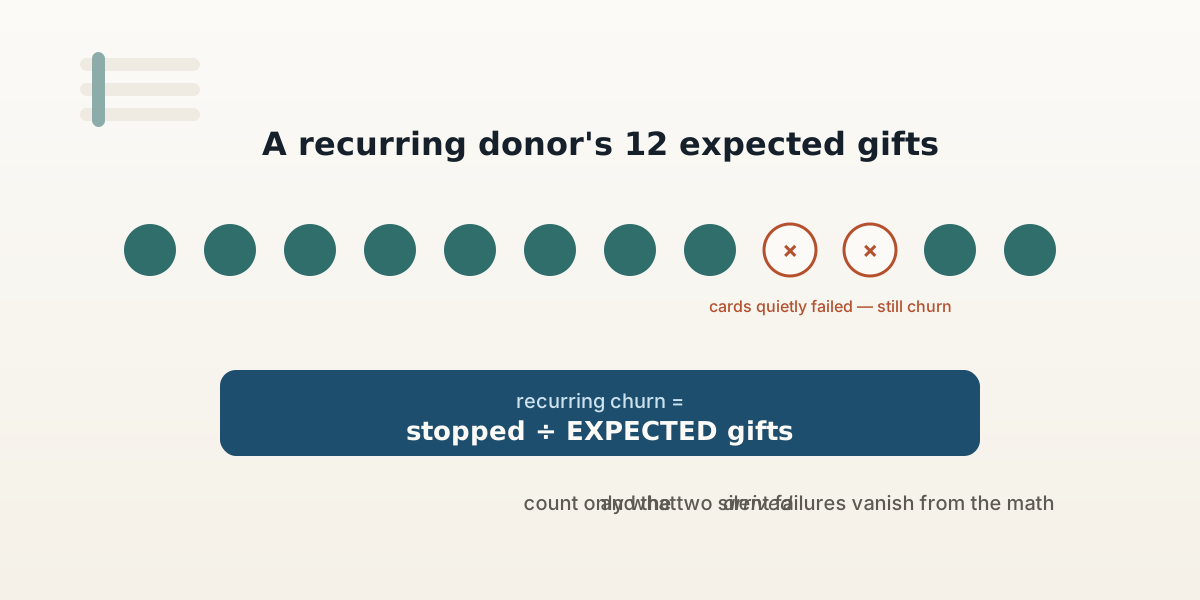
Recurring donor churn is the rate at which recurring (sustainer) commitments stop being fulfilled. The number almost everyone gets wrong isn’t the numerator. It’s the denominator. Churn has to be measured against expected gifts, not received ones. Count only what arrived, and a quietly-failed credit card looks like nothing happened, so your most common form of churn becomes invisible.
How do you measure recurring donor churn?
You compare the recurring gifts you should have received in a period against the ones that actually stopped. The denominator is the set of expected charges implied by your open recurring commitments, not the set of payments that landed.
- Numerator: recurring commitments that stopped being fulfilled (cancelled or quietly failing).
- Denominator: the recurring gifts you expected this period, given the open commitments.
If a donor pledged $50/month and the card fails in month seven, that’s churn the moment the expected charge doesn’t arrive, whether or not anyone cancelled anything.
Why the denominator must be “expected, not received”
A received-only view can only see gifts that exist. But churn is, by definition, about gifts that should exist and don’t. Measuring churn against received gifts is like measuring no-shows by counting the people who showed up: the very thing you’re trying to detect is the thing that’s missing from your data.
You can’t find a missing payment by counting the payments you got. Churn lives in the gap between expected and received, so the denominator has to be “expected.”
The silent failure most shops never see
There are two kinds of recurring churn, and the dangerous one is quiet:
- Voluntary churn: the donor cancels. You get an event; it’s visible.
- Involuntary churn: the card expires or a charge fails. Nothing happens in your CRM. No cancellation, no flag, just an absence.
Involuntary churn is often the larger share, and it’s recoverable (a quick “update your card” note), but only if you can see it. You can only see it if your data knows a payment was expected, which means the recurring commitment has to be modeled as its own thing, separate from the transactions that fulfil it.
That commitment-vs-transaction distinction is the same one behind a pledge is not a payment, and it’s exactly why a system that flattens both into “a gift” simply cannot compute recurring churn correctly.
A worked example
A synthetic sustainer pledged $50/month. Ten charges succeed; in months seven and eleven the card fails (illustrative):
- Received-only view: “10 gifts this year, donor looks active.” The two failures are invisible. You learn about them when the annual revenue comes up short.
- Expected-vs-received view: 12 expected, 10 received → 2 failed charges flagged in months seven and eleven, in time to send a card-update nudge and recover the gift.
Same donor, same data. One view loses revenue silently; the other recovers it.
What you need to compute it
Received-only data can't see involuntary churn
If your system only records gifts that arrived, every failed card looks identical to a perfectly healthy donor between charges. To measure churn you need the recurring commitment modeled separately (with its expected schedule) so a missing charge becomes a detectable event, not just silence.
That separation (commitment as a first-class object, distinct from the transactions that pay it) is part of the shared data model; see what is the Advancement Common Data Model?. The precise numerator, denominator, and time basis for recurring_churn live in the open metric-definitions repository.
What you get
Early warning on the churn you currently learn about months late, a concrete recovery path for involuntary failures (which are the easiest donors to win back, since they didn’t mean to leave), and a sustainer program whose health you can actually measure instead of estimate.
For the builder/standard view, see The Standard (ACDM); to locate your shop on the ladder, take the self-assessment.
Examples use synthetic data. The standard is open and early; treat current releases as drafts.
Related Articles
Programs, beneficiaries, and grants: modeling the half of your data that isn't fundraising
Programs, beneficiaries, grants, and impact belong in the same data model as gifts. Connecting money to mission starts with one shared spine. Here's how.
Tithes, pledges, and three databases: mapping church giving to a common model
Yes, church giving maps to a common data model: members are constituents, tithes are gifts, pledge campaigns are commitments. Here's the full crosswalk.
Who is the Advancement Common Data Model for?
ACDM is for any organization that raises money: advancement shops in the beta today, with churches, hospitals, and human-services nonprofits designed in.