
 Fundraising Commons Team 4 min read
 What is a vendor-neutral common data model, and why fundraising needs one
About the Author
The open, vendor-neutral commons behind the Advancement Common Data Model (ACDM™) and its free educational resources. We write about trustworthy advancement data, portability, and AI-readiness for fundraising teams of any size. Stewards are credited in the colophon, never in the byline.
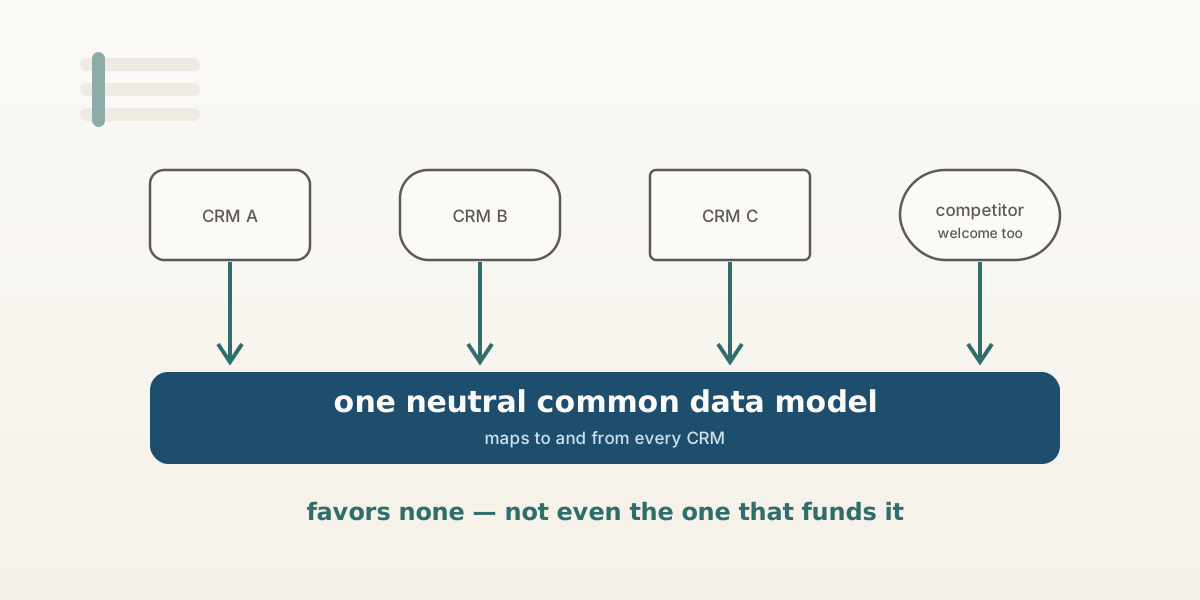
A vendor-neutral common data model is a shared, openly governed way to describe your data that no single software company owns or controls. Every system can map to and from it, so your records mean the same thing everywhere and can move between tools without losing their meaning. Fundraising needs one because advancement data is trapped and reshaped by every CRM, and a model controlled by one vendor would just move the trap, not spring it.
What is a vendor-neutral common data model?
Break the phrase into its three load-bearing words:
- Common: one agreed shape that many different systems can express, instead of each CRM inventing its own.
- Data model: the entities and relationships (constituent, gift, designation, campaign, relationship, interaction) named once, in the open. (If those six are new to you, start with the six objects every advancement CRM has.)
- Vendor-neutral: governed in the open, owned by no company, so adopting it doesn’t hand any vendor leverage over you.
Why “vendor-neutral” is the part that matters
Plenty of vendors offer a data model. The catch is that a model one company controls doesn’t remove lock-in. It relocates it. You’re still standing on a shape that company can change, deprecate, or price, and your portability lasts exactly as long as their goodwill.
A model that a competing system can adopt is, by definition, not any one company’s product. That competitors can conform is the strongest possible proof of neutrality.
Neutrality is what turns “a data model” into “a public good.” It’s the difference between a standard you can build a sector on and a feature you can be charged for.
Why fundraising needs one
The pain is specific to advancement data, and it’s structural:
- Trapped twice over. Your data is siloed inside your institution and shaped by your CRM, so you can’t easily move it or compare it to anyone else’s.
- You can’t benchmark. Without shared definitions, comparing your retention to a peer’s is comparing two different calculations, which is worse than not comparing at all.
- AI raises the stakes. Agents and analytics are only as good as the data beneath them, and “good” increasingly means portable, defined, and connected, which is exactly what a neutral model provides.
How neutrality is kept honest
Calling something neutral doesn’t make it so. The properties that have to be true, not just claimed:
- Open governance. Decisions are made in public, by multiple stakeholders, not set by whoever sells the most software.
- Conformance anyone can claim. Any system, including competitors, can map to the model and demonstrate it. A standard a rival can adopt isn’t a product.
- It maps to and from every CRM, favoring none. The test is that adopting it makes leaving any tool easier, including the tools built by whoever funds the work.
Early, and judged on proof
A neutral standard earns trust over time, through real, visible governance and the first competitors who adopt it, not by assertion. The model here is in an alpha stage and evolving in the open; treat current releases as drafts and watch what the governance actually does.
What you get
Three wins, and they build on each other. Portability: your history is expressed in terms no vendor owns, so migration stops being a hostage situation. Reconciliation: two of your own systems can be lined up because they map to the same shape. Comparability: once everyone’s “retention” means the same thing, the sector can finally learn from itself without exposing a single donor record.
The concrete, fundraising-specific instance of all this is the Advancement Common Data Model. What it covers and how to adopt it is laid out in what is the Advancement Common Data Model (ACDM)?.
This model didn’t start neutral or polished. It began as a set of raw SQL tables and matured over years of listening to the field about what was actually needed. That story is here.
For the leadership view of building on an open foundation, see How It Works; for the builder view, The Standard (ACDM).
Examples use synthetic data. The standard is open and early; treat current releases as drafts.
Related Articles
Programs, beneficiaries, and grants: modeling the half of your data that isn't fundraising
Programs, beneficiaries, grants, and impact belong in the same data model as gifts. Connecting money to mission starts with one shared spine. Here's how.
Tithes, pledges, and three databases: mapping church giving to a common model
Yes, church giving maps to a common data model: members are constituents, tithes are gifts, pledge campaigns are commitments. Here's the full crosswalk.
Who is the Advancement Common Data Model for?
ACDM is for any organization that raises money: advancement shops in the beta today, with churches, hospitals, and human-services nonprofits designed in.